NFL in a Hurry
If you are like me and got into America’s favorite pastime late in life, this cheatsheet is for you. I decided to put together all the questions that I asked (and perhaps annoyed) my partner, that one friend who is really into the game, and AI assistants.
What is American Football?
Q: How many teams?
There are 32 teams in the NFL.
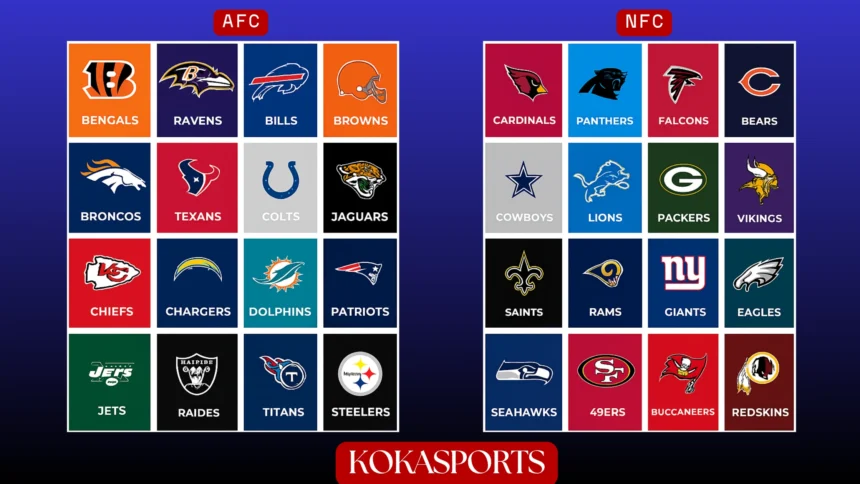
Q: How are they divided into AFC vs NFC and each divisions?
The 32 teams are split equally into two conferences, the American Football Conference (AFC) and the National Football Conference (NFC). Each conference has 16 teams, further divided into four divisions (East, North, South, and West), with four teams in each division.
Q: How many players in each team?
Each team can have a maximum of 53 players on its active roster (though only 48 may be active on game days), but only 11 players from each team are allowed on the field at any one time during a play.
Q: How many yards in the field?
An NFL field is 100 yards long between the goal lines, with an additional 10-yard end zone at each end.
Q: How long is the game?
An NFL game has an official game clock of 60 minutes, divided into four 15-minute quarters. However, the actual time a game takes to complete from kickoff to the final whistle is typically around 3 hours and 12 minutes due to frequent stoppages for timeouts, commercials, penalties, and replay reviews
Q: What is the objective of the game?
The objective is for one team to score more points than the other team within the allotted game time by advancing the ball into the opponent’s end zone for a touchdown (6 points) or kicking a field goal (3 points). Team with most points at the end of the alloted time wins.
Q: What is system of downs?
Gaining 10+ Yards: If the offense successfully moves the ball 10 yards or more within those four tries, they are awarded a First Down. This resets the count, giving them a fresh set of four downs to gain the next 10 yards.
Failing to Gain 10 Yards: If the offense fails to reach the 10-yard mark after three tries, they typically use the fourth down to either punt the ball (kicking it away to push the opponent further back) or attempt a field goal if they are close enough.
The defense While the offense tries to move forward, the defense achieves its objective by preventing that 10-yard gain. They aim to force a punt, create a turnover (by intercepting a pass or recovering a fumble), or stop the offense on fourth down.
Q: What is the psi in the football?
NFL game balls must have an inflation level between 12.5 and 13.5 pounds per square inch (psi).
Q: Do they use the same ball for the entire duration of the game?
No. Multiple game balls are used throughout the game. Each team provides balls for when they are on offense. The balls are inspected before the game to ensure they meet the 12.5-13.5 psi range.
Q: Why is there two clocks?
There are two main clocks:
Game Clock: Tracks the total time remaining in the quarter or game. Play Clock: A 40-second clock (sometimes 25-second) that limits the time between the end of a play and the start of the next one. A delay of game penalty occurs if the ball is not snapped before the play clock reaches zero.
Q: What are the different roles in each team?
offense (attempts to score when they have the ball)
defense (attempts to stop the opponent from scoring)
special teams (used during kicking plays).
Q: What are the various positions played?
Offense: Quarterback (QB), Running Back (RB), Wide Receiver (WR), Tight End (TE), Offensive Tackle (OT), Offensive Guard (OG), Center (C).
Defense: Defensive End (DE), Defensive Tackle (DT), Linebacker (LB), Cornerback (CB), Safety (S).
Special Teams: Kicker (K), Punter (P), Long Snapper (LS), Kick Returner (KR), Punt Returner (PR).
Q: Is there any restriction on how many players with certain role can be on the field?
Yes, while 11 players are on the field, there are rules governing the alignment and number of players doing certain actions.
Offense: Must have at least seven players on the line of scrimmage, with the ends of the line being eligible receivers. Only one player can be in motion at a time before the snap.
Defense: Can align however they want.
Substitutions: Teams can substitute any number of players between plays, but the offense must wait for the defense to set after a substitution.
Q: What is coaching hierarchy?
The typical NFL coaching hierarchy flows from ownership down to position-specific coaches:
Owners/General Manager: The General Manager (GM) usually has authority over football operations, including the draft, free agency, and evaluating the coaching staff.
Head Coach: The head coach is the primary leader, overseeing all aspects of the team and responsible for overall performance.
Coordinators: Offensive, Defensive, and Special Teams Coordinators manage their respective units and usually call plays. They report to the head coach.
Position Coaches: These coaches specialize in specific position groups (e.g., Quarterbacks, Wide Receivers, Defensive Line) and report to the relevant coordinator.
Assistant Coaches: Various assistants help position coaches and perform quality control tasks.
Q: How many captains are there?
Most teams have multiple captains (typically 1-3 for each unit) who are considered leaders in the locker room and on the field. QB is not always the captain of the offense.
Q: What does a captain do?
The primary formal duties of an NFL captain during a game are:
Coin Toss Participation: Up to six captains from each team go to the center of the field for the coin toss before the start of the game and overtime. One designated captain calls “heads” or “tails”.
Penalty Decisions: The captain on the field for the offended team is the one who communicates to the referee whether the team will accept or decline a penalty enforced by rule.
Communication with Officials: While any player can talk to a referee, officials primarily communicate key decisions and general team behavior with the team captain
The Game
Q: Who gets call the toss? What do winner of toss get to decide?
The visiting team captain calls the coin toss at the beginning of the game. The winner of the toss can choose one of the following options:
- To receive the kick.
- To kick the ball.
- Which goal they wish to defend.
- To defer their choice to the second half.
Q: What do loser of toss get to decide ?
The loser of the coin toss gets the remaining option not chosen by the winner. For example, if the winner chooses to receive the kick, the loser gets to choose which goal they will defend.
Q: Do the refs whistle each play end?
Yes, officials whistle the end of each play to indicate that the ball is dead, usually when the player with the ball is tackled to the ground, goes out of bounds, or a forward pass falls incomplete.
Q: What is kickoff?
When: Start of each half, after scores (field goal, touchdown).
Type: Place kick or drop kick.
Rules: A type of free kick; once it travels 10 yards, it’s a live ball for either team.
Q: Where do the receiving team start when the kicking team kicks the ball to the end zone?
If the kicking team kicks the ball into the end zone and the receiving team catches it and kneels (a touchback), the receiving team starts its drive at its own 25-yard line.
Q: Where do receiving team start when ball is kicked out of bounds before the end zone?
If a kickoff goes out of bounds before reaching the end zone, the receiving team can choose to take the ball 25 yards from the spot where it went out of bounds or 30 yards from the spot of the kick, effectively giving them better field position.
Q: When do they get to start at own 35?
The receiving team starts at their own 35-yard line following a touchback resulting from a free kick after a safety, not a kickoff. It also used to be the standard starting position for all kickoffs before a rule change established the 25-yard line.
Q: When do teams swap sides?
Yes, teams swap ends of the field at halftime. They also swap ends at the end of every quarter.
How it works:
Start of Game (1st Quarter): A coin toss determines who receives and who chooses which end to defend.
End of 1st Quarter: Teams switch ends of the field. Play resumes at the same yard line but in the opposite direction.
Halftime: Another coin toss occurs. The winner chooses either to receive the kickoff or to pick which end of the field to defend for the second half.
End of 3rd Quarter: Teams switch ends again, just like after the first quarter, to balance conditions for the final quarter.
Why they do it:
Fairness: To prevent one team from having a significant advantage due to strong wind, bright sun, or even a slight slope in the field.
Balance: By switching every quarter (and after halftime), each team gets to play with and against the elements for roughly equal amounts of time.
Q: What stops the play clock?
The play clock stops during:
- Timeouts (team or injury).
- The two-minute warning in each half.
- Scoring plays.
- Changes of possession.
- After an incomplete pass or a runner goes out of bounds (game clock stops, play clock starts).
- For penalties.
- For a measurement.
- At the end of a quarter.
Q: What are all the colors of flags used?
Yellow flags are thrown by officials to indicate a penalty has occurred.
Red challenge flags are thrown by head coaches to challenge a reviewable official’s decision (except in the final two minutes or overtime when all reviews are initiated by the replay official).
Q: How many flags are there?
There are several yellow penalty flags carried by the referees, and each head coach is given two red challenge flags per game (if applicable).
Q: What is a Hail Mary pass?
A Hail Mary pass is a very long, low-probability forward pass made in desperation by the offensive team with little time left on the clock. The goal is a touchdown, and it usually involves the quarterback throwing the ball high into the end zone, hoping a receiver can catch it amidst many players.
Q: What is red zone?
The red zone is the unofficial area of the field from the opponent’s 20-yard line to their goal line. Teams track efficiency in this area, as the field is more condensed and scoring a touchdown can be more difficult.
Q: What is a pocket?
The pocket (or “pocket area”) is the area behind the line of scrimmage where the offensive linemen form a protective semi-circle around the quarterback. It extends laterally to the ends of the offensive line and runs approximately two yards deep.
Q: What is an onside kick?
An onside kick is a deliberate short kickoff where the kicking team attempts to recover the ball themselves after it travels at least 10 yards. It is a risky play, typically attempted at the end of a game when a team needs possession to try and score quickly.
Q: What is the role of the center? The one that hikes the ball?
The center is an offensive lineman responsible for snapping (hiking) the ball to the quarterback (or punter/holder) to start a play. The center also makes calls to the other offensive linemen regarding defensive alignments and blocking schemes.
Q: When is it ok to tackle a QB?
A QB can be touched and tackled just like any other player in possession of the ball. However, the defense cannot engage in “roughing the passer,” which involves hits to the head/neck, hits below the knees (except in specific cases), or driving the QB into the ground with excessive force.
Q: Who is safety?
Safety is a defensive position in the secondary, typically the players furthest from the line of scrimmage. Their main roles include covering deep passes, assisting in run support, and acting as the last line of defense. There are usually two types:
Free Safety (FS): Usually plays deeper, covering the entire field against long passes. Strong Safety (SS): Often bigger, plays closer to the line to help defend runs and cover tight ends/slot receivers.
Q: What is safety?
A safety is a scoring play that results in two points for the defensive team. It occurs when the offensive player with the ball is tackled in their own end zone, the ball goes out of bounds in the end zone, or the offense commits a foul in their own end zone. The team that scores the safety then receives a free kick from the opponent’s 20-yard line.
Q: What is turnover on downs?
A turnover on downs occurs when an offensive team fails to achieve a first down after all four of their allotted downs (plays). The opposing team takes possession of the ball at the spot where the play ended. Teams usually punt or attempt a field goal on fourth down to avoid this.
Q: What is lateral or backwards pass?
A lateral pass or backwards pass is a pass that is thrown, handed, or pitched to another player on the same team in a direction that is parallel to or behind the line of scrimmage. It is treated differently than a forward pass in that if the ball hits the ground, it is a live ball and can be recovered by either team.
Q: Why is backward pass ball a live ball eve after it touches the ground?
Because a backward pass is treated the same as a fumble once it hits the ground. Either team can recover it, and the play continues.
Q: What is a fumble?
A fumble is when a player who has possession and control of the ball loses it before the play is whistled dead. Like a backward pass that hits the ground, a fumbled ball is a live ball and can be recovered by either the offense or defense.
Q: What are the criteria for a completed pass? Knee/elbow/control ?
For a completed pass, a receiver must:
- Secure control of the ball.
- Get two feet (or another body part, like a knee or elbow) down in bounds.
- Maintain control of the ball throughout the process of contacting the ground.
Q: Can the ball touch the ground and still be a completed pass?
No, generally if the ball touches the ground during the process of a catch, it is an incomplete pass. However, if the receiver has established control and is already down with two feet, and the ball touches the ground after that, it can still be a complete pass if control is maintained.
Q: What counts as sack?
A sack is credited to a defensive player when the quarterback is tackled or forced out of bounds behind the line of scrimmage before throwing the ball away (except if it’s intentionally grounded). It is a sack regardless of whether the QB is inside or outside the pocket when tackled.
Q: Can any one catch/run the ball? Ex: linebacker
Yes, any player on the field can run with the ball once they gain possession (e.g., intercept a pass, recover a fumble, catch a lateral). A linebacker can intercept the ball and run it back for a touchdown, which is often called a “pick 6”.
Q: What are 4th quarter rules?
For the most part, rules in the 4th quarter are the same as the first three quarters. The main difference is the two-minute warning, an automatic official’s timeout when the game clock reaches 2:00 in both the 2nd and 4th quarters. This also changes rules regarding the game clock stopping and starting.
Q: What are 2 min rules?
The “two-minute warning” is an automatic timeout. Key rule implications: The game clock stops automatically. The clock starts on the snap after the warning. Fumbles or backward passes recovered by the offense no longer automatically run the clock (only the player who fumbled or last touched it can advance it legally if the clock is running). This is called the “force out” rule or “Bernie Kosar” rule.
Q: What is pick 6?
A “pick 6” is an interception (pick) that is returned for a touchdown (worth 6 points plus the extra point attempt).
Q: What is an interception?
An interception is when a forward pass intended for an offensive receiver is caught by a player on the defensive team. The defensive team then gains possession of the ball (a turnover).
Q: When do they do 10sec runoff?
A 10-second runoff of the game clock can occur late in a half when the offense commits a specific penalty (e.g., an intentional foul to stop the clock) or if the ball is illegally batted or kicked forward to preserve time. It essentially runs off time the offense tried to save.
Q: What calls can be challenged by the coach?
Coaches can challenge most on-field calls, including scoring plays, fumbles, completed/incomplete passes, runner down by contact, and boundary calls. Challenges are reviewable by instant replay. Certain subjective calls (e.g., holding, pass interference - though pass interference was reviewable for one season) cannot be challenged.
Q: What is injury timeout?
An injury timeout is a temporary stoppage in play called by the referee for an injured player. There is no limit to the number of injury timeouts, but a player who causes a stoppage to get medical attention must leave the field for at least one play, except in some specific cases such as after a score or a change of possession.
Q. What are the overtime rules?
In the regular season, overtime lasts a maximum of 10 minutes. The first team to score wins, unless the first team only scores a field goal; in that case, the other team gets a possession to try to score. If the second team scores a touchdown, they win. If they kick a field goal and tie the game, the game continues until the next score or the clock runs out (resulting in a tie). In the playoffs, overtime is a longer period, and the game cannot end in a tie. Both teams are guaranteed one possession regardless of the score.
Q: When can the offense take a knee to skip a turn? At what play clock is the team guarantied victory and they take a knee?
A “kneel down” (or “victory formation”) is when the quarterback receives the snap and immediately kneels down, ending the play and running the game clock. The team uses this to run out the clock when the opposing team has no timeouts left and the victory is essentially guaranteed. There isn’t a specific play clock timing, but it usually happens with under a minute left if the opponent has no timeouts, or around 40 seconds left if they have one or two.
Q: What is defensive coverage? How many types are there?
Defensive coverage refers to how the defense aligns and assigns players to cover offensive receivers. There are many types, but they generally fall into two main categories: Man Coverage: Each defensive back is assigned to a specific offensive receiver and follows them wherever they go. Zone Coverage: Each defensive player is responsible for covering a specific area (zone) of the field, and they cover any receiver who enters that zone.
Q: What is neutral zone?
Before the ball is “snapped” (put into play from the line of scrimmage), there is a specific, imaginary area on the field called the neutral zone. It is exactly the length of the football: 11 inches wide. It sits between the offensive team’s line of scrimmage and the defensive team’s line of scrimmage. Crucially, no player from either team is allowed to enter or be in the neutral zone before the snap.
Penalty
Q: Which penalties result in half a distance to goal?
Several penalties, often those that are severe or happen near the goal line, result in a loss of half the distance to the goal instead of the standard yardage:
- Roughing the passer.
- Pass interference.
- Various personal fouls.
- Any penalty by the offense from within its own 20-yard line that would normally result in a loss of too many yards.
Q: Which penalties are spot foul?
A spot foul penalty is one where the yardage is enforced from the spot where the foul occurred, not the line of scrimmage or the end of the play. Foul after a change of possession. Defensive holding (can be spot foul in certain areas).
Q: What is roughing the passer?
Roughing the passer is a personal foul penalty (15 yards and an automatic first down) called when a defensive player uses excessive force against the quarterback, hits the QB in the head or neck area, hits below the knees, or lands on the QB with their full body weight.
Q. What is pass interference?
Pass interference occurs when a player significantly hinders an eligible receiver’s ability to catch the ball through contact while the ball is in the air. In the NFL, it is a 15-yard penalty from the line of scrimmage and an automatic first down for the offense if committed by the defense.
Q: What is intentional grounding?
Intentional grounding is called when the quarterback (while in the pocket) throws the ball away to avoid a sack, and the ball does not reach an eligible receiver. The penalty results in a loss of down and 10 yards from the line of scrimmage (or a spot foul if in the end zone, resulting in a safety).
Q. Why is it not a foul when a QB throws it out of bounds?
It is not a foul when the QB throws the ball out of bounds if: The QB is outside the pocket when they throw the ball away. The ball travels beyond the line of scrimmage.
Q: How are penalties applied when personal fouls happen after touch down or after field goal?
If an opponent commits a personal foul after a touchdown or field goal, the penalty is typically enforced on the ensuing kickoff or the extra point attempt (depending on the timing and type of foul), not negating the score.
Q: What’s the rule about touching the center?
Defensive players are not allowed to make contact with the center (long snapper) until one second has elapsed after the snap, as they are in a vulnerable position. Doing so results in a penalty.
Q: What are the types of personal fouls?
Personal fouls are 15-yard penalties and include: Roughing the passer. Roughing the kicker or holder. Facemask (grabbing an opponent’s facemask). Unnecessary roughness. Unsportsmanlike conduct. Taunting. Chop blocks.
Q: When does a player get ejected from the game?
A player can be ejected from the game for committing multiple unsportsmanlike conduct penalties in a single game, or a single egregious act of violence or fighting.
Q: When does a player get fined?
Players can be fined by the NFL for various infractions, including dangerous hits, unsportsmanlike conduct, uniform violations, and other actions deemed detrimental to the league. Fines are monetary penalties.
Q: Can a coach get a flag? How is that enforced?
Yes, a coach can get an unsportsmanlike conduct penalty (a yellow flag) for arguing excessively, going onto the field, or other egregious behavior. The penalty is 15 yards against their team. A second unsportsmanlike conduct penalty in the same game usually results in ejection for the coach.
Q: Is it a sack if QB is outside the pocket?
Yes, it is still considered a sack if the quarterback is tackled behind the line of scrimmage, regardless of whether they are in the pocket or outside of it.
Q: What is false start? Who or how many player can move before snap?
A false start is an illegal movement by an offensive player after they have lined up for the snap and before the snap occurs. It results in a 5-yard penalty. Generally, no offensive players are allowed to move (except one player in motion) once the quarterback begins their cadence or is under center. Defensive players can move as long as they do not cross the neutral zone and make contact or cause an offensive player to jump.
Q: What is Offsides, Encroachment, and Neutral Zone Infringement?
These three terms are often used interchangeably in casual conversation, but in the official NFL rulebook, they have specific distinctions relating to when contact occurs. All of these result in a 5-yard penalty against the defense:
- Offsides This is the most common and general term. A defensive player is considered “offsides” if any part of their body is in the neutral zone when the ball is legally snapped. The play usually continues, and the offense has the option to decline the penalty if the play resulted in a big gain for them (this is called “free play”).
- Encroachment Encroachment is a specific form of offsides where a defensive player crosses the line of scrimmage and makes contact with an offensive player before the ball is snapped. The official immediately blows the whistle to stop the play as soon as contact is made.
- Neutral Zone Infringement This is closely related to encroachment. A defensive player enters the neutral zone and causes an offensive player to react (e.g., flinch or move) or makes clear movement toward the offense that forces an immediate whistle to stop the play. The key is that the foul occurs before the snap, stopping the action.
Matchup
Q: How is away vs home games and opponents decided?
The NFL schedule is formulaic, with teams guaranteed to play certain opponents based on division rotation and previous year’s finish, ensuring a balanced schedule. Divisional Opponents: Each team plays its three division rivals twice (home and away) each season. Conference & Non-Conference: Rotates playing all teams in an entire division from the same conference and an entire division from the other conference over a multi-year cycle. Placement Games: Two games are scheduled against teams from remaining divisions in the same conference based on the previous season’s standing (e.g., all 1st place teams play each other). Home vs. Away: Alternates which divisions are played at home or away each year.
Q: Which division plays which division in cross conference games?
This rotates on a four-year cycle, ensuring that every team plays every other team in the league at least once every four years.
Q: Why do teams meet more than once sometimes?
Teams meet more than once if they are in the same division (play twice a year guaranteed) or if they meet in the playoffs after playing in the regular season.
Q: How is the tie record broken when ranking the teams with same record for playoffs
The NFL uses a complex tie-breaking system to determine playoff seeding for teams with the same record. The criteria, in order, include:
- Head-to-head record (if applicable).
- Division record (if within the same division).
- Common games record.
- Conference record (if cross-conference).
- Strength of victory.
- Various other strength of schedule or points-based metrics.
Q: What is the ranking implication in playoff? Who gets to play whom and where?
- Seven teams from each conference make the playoffs (four division winners and three wild cards).
- The top seed in each conference gets a first-round bye.
- The other division winners (seeds 2-4) host the wild card teams (seeds 5-7).
- Seeding determines matchups, with the highest seed playing the lowest seed in each round.
The higher-seeded team always hosts the game, ensuring home-field advantage. Accomplishments
Q: What is SNF, MNF, TNF?
- Thursday Night Football
- Sunday Night Footall
- Monday Night Football
Q: When there is games on Saturday, is it called SNF?
No, “SNF” stands specifically for Sunday Night Football. The Saturday NFL games that occur late in the season or during the playoffs do not have a specific, common acronym like SNF or MNF (Monday Night Football). They are usually just referred to as the “Saturday game” or by the network airing them, such as “NFL Network Saturday” or “ESPN Saturday Night”.
Accolades
Q: What is a pro bowl player mean?
A Pro Bowl player means the player has been selected to participate in the Pro Bowl, an annual all-star game featuring the best players from the AFC against the best from the NFC. Selection is based on votes from fans, players, and coaches.
Q: what is Heisman Trophy?
The Heisman Trophy is an annual award presented to the most outstanding player in National Collegiate Athletic Association (NCAA) Division I college football. It is a highly prestigious award for college athletes and does not directly relate to NFL accomplishments (though many Heisman winners go on to play in the NFL).
Q: How is defensive payer of the year selected?
The NFL Defensive Player of the Year is an annual award given to the league’s best defensive player. The winner is determined by votes from a panel of 50 sportswriters.
Q: How is offensive player of the year selected.
Similar to the defensive award, the NFL Offensive Player of the Year is an annual award given to the league’s best offensive player, determined by votes from a panel of 50 sportswriters.
Q: Is there an MVP in each game?
No, there is not an official NFL MVP award for every game during the regular season. The main NFL Most Valuable Player (MVP) award is a single, season-long honor, and a different award is given for the Super Bowl. Season MVP
Regular Season MVP: award voted on by a panel of 50 sportswriters and media members at the end of the regular season. The winner is announced at the annual NFL Honors ceremony before the Super Bowl.
Super Bowl MVP: The only official “game MVP” award is the Pete Rozelle Trophy, presented to the Most Valuable Player of the Super Bowl itself. This is a single-game honor, and the voting process includes both a media panel and a fan vote.
Q: why do the commentators call some players future hall of famers?
“Future Hall of Famer” is an unofficial title for an NFL player whose elite performance and career achievements strongly suggest they will be inducted into the Pro Football Hall of Fame.
This label is earned through factors like numerous All-Pro selections, significant career milestones (e.g., 10,000 rushing yards or 100 sacks), and a prolonged, dominant impact on the sport.
It is a subjective term used by analysts to identify players expected to meet the high standards of the selection committee five years after they retire
Q: What are the bowls in NFL?
The Bowls (Postseason Games)
The term “bowl” originates from the shape of stadiums, specifically the Rose Bowl. In the NFL, there are two main “bowl” events:
Conference Championships: These are the AFC and NFC Championship games held annually to determine the champions of each conference who will advance to the Super Bowl.
The Super Bowl: This is the pinnacle of the NFL, the annual championship game played between the AFC and NFC champions to determine the league champion. The Pro Bowl: This is the NFL’s all-star game, featuring top players from the AFC and NFC, typically played the week before the Super Bowl
Q: What are the trophes that go with the bowls?
Vince Lombardi Trophy: The most coveted team award, presented to the winner of the Super Bowl. A new sterling silver trophy is handcrafted by Tiffany & Co. each year for the winning team to keep permanently.
Lamar Hunt Trophy: Awarded to the champion of the AFC (American Football Conference).
George Halas Trophy: Awarded to the champion of the NFC (National Football Conference).
Pete Rozelle Trophy: Presented to the Super Bowl Most Valuable Player (MVP).
Analytics
Q: what’s are all the numbers mean in the qb rankings?
QB rankings often refer to the NFL’s official passer rating system. It is a complex formula that takes into account four main statistical categories:
- Completion percentage.
- Yards per attempt.
- Touchdown percentage.
- Interception percentage. Each category is weighted and calculated to produce a single rating number (with a perfect passer rating being 158.3).
Q: How is the defensive team ranked? What they measure and how?
Defensive team rankings typically rely on various metrics, including:
- Total yards allowed per game (run and pass defense).
- Points allowed per game.
- Turnovers generated (interceptions and fumbles recovered).
- Third-down conversion percentage allowed.
- Red zone efficiency allowed (how often opponents score a TD once in the red zone).
Q: What is turnover differential?
Turnover Differential: The difference between the number of times a team forces a turnover (interceptions, fumbles recovered) and the number of times they commit one.
Other Terms
Q: What is a chip shot?
A chip shot refers to a very short and easy field goal attempt, typically from within the opponent’s 20-yard line.
Q: What is “hut”?
“Hut” is a common sound or word used by the quarterback as part of their pre-snap cadence. The cadence is a series of verbal signals used to communicate timing and snap the ball. “Hut” is a sharp, loud sound used to signal the center to snap the ball or to indicate when the play will start.
Q: What is “blitz”?
A blitz is a defensive strategy where the defense sends additional players (more than the standard four rushers) to pressure the quarterback. The goal is to sack the QB or force a quick, potentially inaccurate throw.
Q: Why do qb do the thing with their leg?
Quarterbacks often lift or stomp their leg before the snap for several reasons:
- To signal a change in the cadence or play.
- To draw the defense offsides (get them to cross the line of scrimmage before the snap).
- To adjust player positions.
Q: Why do they trade players mid season?
Teams trade players mid-season, before the trade deadline (typically after Week 9), for various strategic reasons. Reasons include:
- Acquiring missing pieces for a potential playoff run.
- Managing salary cap issues.
- Filling in for injured players.
- Acquiring draft picks for future seasons as part of a rebuild.
- Shedding salary or players who do not fit the team’s system.
Q: How is draft pick order decided?
The NFL Draft order is primarily determined by the previous season’s standings. The team with the worst record from the previous season gets the first pick in the draft. The order generally proceeds in reverse order of finish, with playoff teams drafting later, and the Super Bowl champion drafting last in the first round.
Q: Why different Jersey for different game?
Teams use different jerseys to distinguish themselves on the field (one team in white, the other a darker color), to comply with league rules, and for marketing purposes.
- Home vs. Away: Home teams declare their jersey color for the season (usually their primary color), and visiting teams must wear the opposite, typically white.
- Alternate/Throwback: The NFL allows teams to wear alternate or throwback jerseys up to four times per season, often tied to special events or fan nostalgia.
- Replacements: Players are often issued new jerseys multiple times a year, not necessarily for every game, with equipment staff managing the inventory, especially if jerseys are swapped with opponents after a game.
Q: What is 3 and out mean?
“3 and out” means that the offensive team had possession of the ball but failed to get a first down after three plays, forcing them to punt on fourth down.
Q: Which teams have won most super bowls?
New England Patriots and Pittsburgh Steelers have 6 wins. Dallas Cowboys and San Francisco 49ers have 5 wins each.
Q: Whats the relationship between football and thanksgiving?
The relationship between football and Thanksgiving is a deep-rooted American tradition that began with college football in 1876 and was later adopted by the NFL to popularize the league. The tradition was formalized by the Detroit Lions in 1934 and cemented by the Dallas Cowboys in 1966, both seeking national exposure. Today, the NFL hosts three Thanksgiving Day games annually, and the event has become a central cultural element of the holiday celebration.
Q: Where did the “How ‘bout them Cowboys?” came from?
Following a crucial 30-20 win over the San Francisco 49ers, which secured the Cowboys a spot in the Super Bowl for the first time in over a decade, an excited Jimmy Johnson(HC) stood on a table to address his players. In that moment, feeling overwhelmed with emotion and excitement for his team, he was momentarily stumped for words. He looked out at the cheering players and simply said: “How ‘bout them Cowboys?”.
The locker room erupted in cheers, and those four words quickly became a popular, iconic rally cry that is still associated with the franchise and Johnson’s legacy today. The phrase is a registered trademark owned by the Dallas Cowboys Football Club.
Q: Who is John Madden?
John Madden was a legendary figure in the NFL, achieving prominence both as a Super Bowl-winning head coach and as one of the most beloved and impactful sports broadcasters in television history.